
The Redesign Is Coming. Private Schools Should Lead It.
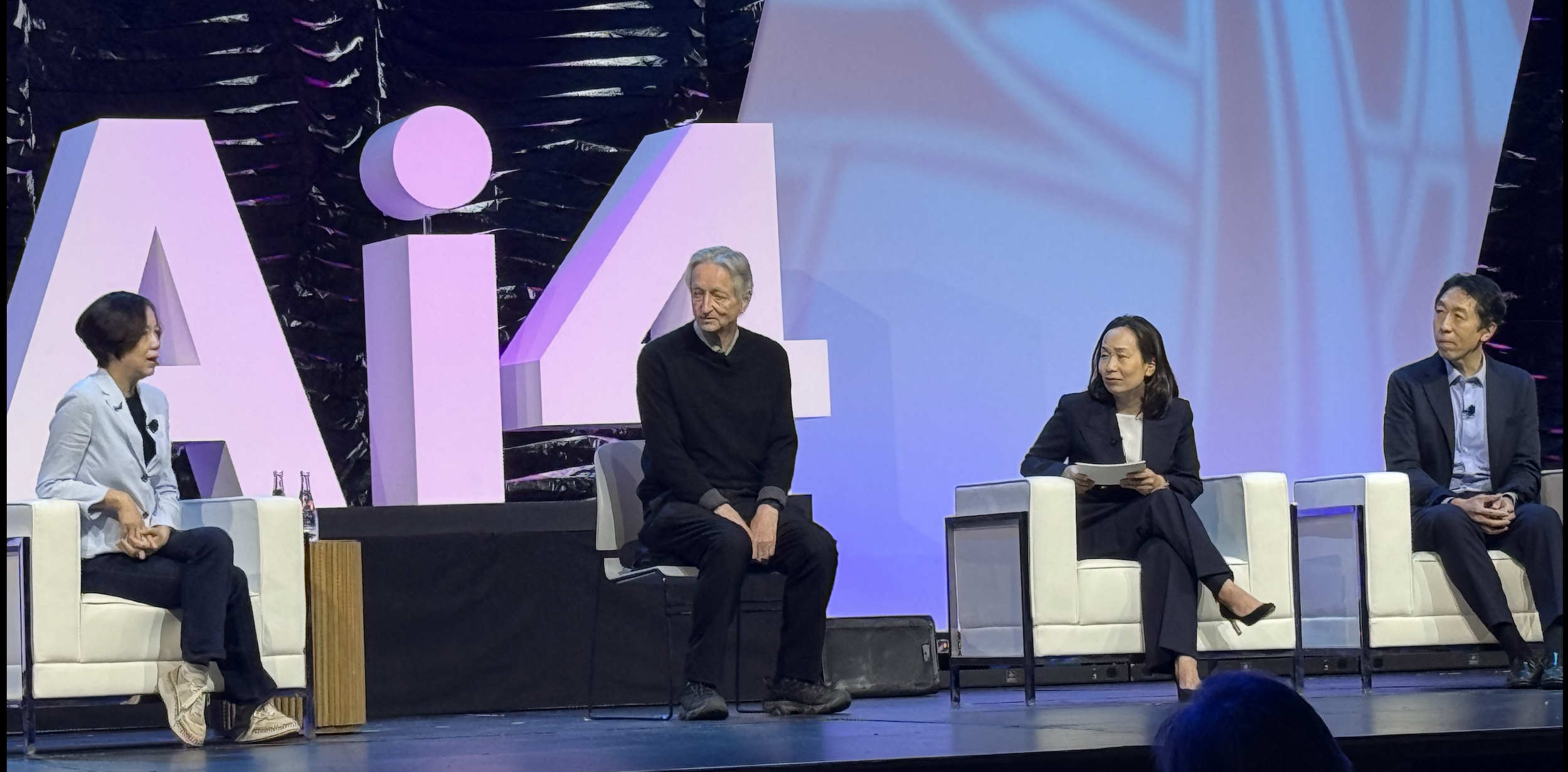
I spent three days this August at Ai4 in Las Vegas. Twelve thousand people, the largest AI conference there is, a mix of the technical and business sides of just about every industry. I went for a specific reason. I wanted to hear how AI adoption is actually going outside the school world, from people with no stake in what schools do and no habit of softening the answer for us.
The highlight was a keynote with three of the researchers who built the foundations of modern AI: Geoffrey Hinton, Fei-Fei Li, and Andrew Ng. I took one idea from each of them and spent the rest of the week testing it against what I know about schools.
Individually, each idea is useful. Together they assembled into an argument I did not board the plane expecting to make: the redesign of how children learn is coming, someone will lead it, and our schools hold the one asset that leading it requires.
Here is how I got there.
The question that decides whether AI takes the job
Start with Nobel laureate Geoffrey Hinton, often called the godfather of AI, and known for his warnings about where all of this is headed.
He told a story about his niece, who works in healthcare answering complaint letters. AI took a task that used to take her 30 minutes down to five. His point was the fear sitting underneath that story, the fear so many people carry that AI is coming for jobs.
Then he refused to treat that as one question.
Whether AI takes the job depends on whether demand for the work is elastic. If the work has a ceiling, a fixed pile that eventually gets finished, then a gain like that really does mean fewer people doing it. If the work has no ceiling, if there is always more of it waiting than anyone has ever had the hours to reach, that very same gain means those same people finally get to it.
One technology, one efficiency gain, two opposite answers. Which one you land on has nothing to do with the AI. It depends on the work.
Let's apply that to schools.
Picture someone in your admissions office whose AI fluency makes her three times more efficient. Does the school now need a third of its admissions staff?
Think about what that office already carries and has never had the hours to reach:
the inquiries that deserved a personal response and got a form letter
the family who toured once and never heard a personal follow-up
the retention conversation that should have happened in October instead of March
That work has always been there. The capacity to reach it never was.
That is what elastic demand looks like in a school. The pile of what could be done, and should be done, finally becomes reachable. I heard versions of this all week in the industry sessions. The organizations furthest along with AI weren't describing smaller teams. They were describing teams that had finally gotten to the work they'd been deferring for years.
Hinton didn't soften the other side. Where the work genuinely does have a ceiling, it is changing, and changing fast. That candor is what makes his question useful rather than just comforting.
So ask it, role by role, at your school: if this person were three times more efficient, would they run out of work, or would they finally get to the work we've all been putting off?
For almost everything that matters in a school, I believe it's the second.
The register a leader has to hold
Answering that question inside your own building is one kind of work. Leading the conversation outside it is another, and it arrives at a school leader's door in a form that has very little to do with capacity.
Fei-Fei Li, the godmother of AI, and the speaker I most wanted to hear, spent the keynote doing the thing I find hardest in my own work: holding the promise and the risk of AI in the same breath, without hype and without fear.
She set that tone in her first few minutes on stage. The opening question was about AI consciousness, exactly the kind of question that pulls a panel straight into speculation. She declined to play: "Let's bring science, not science fiction, back to the AI debate."
Then she said why the extremes trouble her.
"Fear doesn't help people to learn. Fear doesn't help policymakers make the most rational policies."
"The last thing we should do is to debilitate people and take the agency away from people."
Let's apply this to schools.
If you lead a school, you live between those same two poles every week. A trustee forwards the article predicting AI catastrophe. A parent asks why the school isn't using AI for everything yet. Your faculty spans the full spectrum in a single hallway. Both extremes arrive at your door with certainty, and both ask you to react rather than to think.
Fei-Fei Li models a third voice, and I believe it is the leader's voice. It names risks specifically rather than vaguely, and capabilities specifically rather than magically. And it protects people's agency, their room to learn, question, and experiment, which the fear and the hype both take away.
That middle position is also where her credibility comes from. She holds the respect of both camps because she won't flatten the conversation for either one.
That same ground is available to school leaders. Leading your community's AI conversation doesn't require being the most technical person in the room. It requires the discipline to keep the conversation rational, specific, and human, especially when everyone around you is being asked to pick a pole.
At the end of the panel, the moderator asked each speaker for the headline they would want to read five years from now. Hers:
"In five years, we have a headline that, with AI as a tool, the world announces the eradication of illiteracy."
That is the third voice at full strength. She spent the hour refusing to overstate either the risk or the promise, and then, given one sentence, used it to name something specific and enormous that she believes is worth building.
That is a register a school can lead in. You can be honest with your community about what this technology might cost, and still say plainly what you intend it to make possible for your students.
The technology is supposed to disappear
Notice what Fei-Fei Li's sentence was actually about. Not the model, not the capability. An outcome. Literacy.
The third speaker has spent years arguing that this is the only way to talk about any of it.
Andrew Ng is a Stanford professor who founded Google Brain and co-founded Coursera. More than anyone else on that stage, he has spent his career teaching AI to people outside the field, to millions of them.
Years ago, he coined the phrase "AI is the new electricity." He points out that when we think about the invention of the light bulb or the telephone, electricity, the thing that made them both possible, disappears into the background. His hope is that AI headlines will someday read the same way: cancer cured, the energy problem solved, with AI nowhere in the sentence.
That comparison held up across every session I attended. The organizations with the most impressive AI stories talked about outcomes. The ones still finding their footing talked about the technology.
Let's apply this to schools. The private school that navigates the next decade well won't be remembered for adopting AI. It will be remembered for what its students became.
It is worth sitting with how much that reframes. It moves the whole question off the ground where schools have been asked to fight it for three years now, the ground of policy, detection, permission, and platform selection, and puts it back on the ground schools have always been expert on. Not "what is our AI strategy," but "what do we now believe is possible for a child, and what will we build to get there?"
Which raises the question I spent the rest of the conference on. If that is the real question, who is qualified to answer it?
Who leads the redesign
I sought out the education sessions, and they made the case I expected: we can now imagine far more effective ways to help children learn, genuinely personalized, built around each student's motivation. What I didn't expect was how often that same subject surfaced in rooms that had nothing to do with schools. Speakers working on entirely different problems kept finding their way to children, to students, to how people learn.
That is what convinced me this is coming. Not the education track. The fact that people with no professional interest in education kept arriving at it anyway.
When that redesign reaches education, someone will lead it. I spent much of the conference thinking about why our schools are so well positioned to be the ones who do.
Families will try a new tool on their own, and plenty already have. What they will not do is hand a child's education over to one. That decision follows trust, built over generations, carried by teachers and traditions and communities, and that kind of trust lives in our schools.
We usually describe that trust as the reason schools change slowly. As the conference ended, I started to think it might be the opposite: the asset that lets a school lead the change credibly and say to its families, "We know how children learn, we know your children, and we intend to own this redesign rather than have it happen to us."
That is a different sentence from "we're using AI in our classrooms," and the difference is not marketing. One announces a tool. The other claims the expertise, and accepts the responsibility, for what the tool is for. Only an institution that already knows children can say the second one and be believed.
I want to be careful about what I am claiming, because the trust part is real and it is also finite. It draws down. A hype-led rollout that doesn't deliver anything a family can see spends it faster than nothing at all would have. The reservoir is the reason a school gets to lead. It is not a substitute for having something true to say.
But that is a question of execution, and execution is a thing schools are good at when they know what they are building toward. The harder part, the part that took generations and cannot be assembled on a timeline, our schools already have.
The headline I want
Three ideas, from three people who built this technology, none of whom were talking about private schools.
Hinton's question tells you that the capacity is coming, and that in a school it will be absorbed rather than surrendered. Fei-Fei Li's refusal of both poles gives you the register to lead in while your community pulls at you from either side. Ng's electricity tells you what the whole thing is finally for, which is never the technology.
Put them together and you get an institution with more capacity than it has ever had, a credible voice in a conversation everyone else is shouting through, and a reason to point both at something larger than efficiency.
The light bulb got the headline. Electricity made it possible. If our schools get this right, the headlines in our world will be about the students, and the technology underneath will be invisible.
